Interview with Arden Levine on Spoke — June 20, 2026
Arden Levine is the author of Spoke (The Word Works’ Hilary Tham Capital Collection, 2026), a finalist for the 2024 National Poetry Series and included in Ms. Magazine’s Best Poetry of 2025–2026. She is also the author of the chapbook Ladies’ Abecedary (Harbor Editions, 2021). Her poems appear in Barrow Street, Harvard Review, Indiana Review, RHINO, Sixth Finch, and other literary journals. Arden lives in New York City, where her daily work focuses on sustainable social policy and nonprofit leadership. She holds an MPA from New York University’s Graduate School of Public Service and has directed initiatives supporting housing affordability, homelessness prevention, equitable community development, environmental justice, women’s wellness, and behavioral health awareness.
Christopher Nelson: I admire how much you achieve with the word spoke; that single syllable conjures up the power in telling one’s stories and acts as a metonym for bicycle, a symbolic object that frequents your poems. I read each poem functioning as a spoke of the same wheel, each connected to a thematic hub, each working to move the whole.
Arden Levine: Thank you. That homonym really punches above its weight class. I also lucked out in finding two epigraphs that help me sink the line, one from a bike repair book and one from a sensory poem: each discusses motion and tension but uses different definitions for each. (There’s also a third, rather cheeky epigraph… We may come back to her.) Language stays a bit slippery throughout this book; when the tires aren’t hugging the road, the reader may hydroplane by design.
Nelson: A complex father recurs in Spoke. In the first poem we learn that he is dead. Talk, if you would, about how these poems navigate and address the concept of memory.
Levine: I think of that first poem as setting the on-your-guard / off-your-balance tone that reverberates through the collection: it occurs in nonlinear time and inconsistent space. It contemplates a father who is living and/or not (depending on the stanza and the to-be-determined reliability of the poem’s speaker). And it does so by invoking an atypical 1990s jazz song that discusses an 1880s post-Impressionist painter. Also, there is a gun and a hole, and it’s a real gun in the song though it’s a metaphorical gun in the poem, but the hole is always a real hole. If none of that is straightforward, that’s the point: it’s a pop-infused Chekhov setup (complete with gun and fired gun) for how personal recollections become annexed and appropriated by historical context, experiences of trauma, and concurrent cultural stimuli. The rest of the book comes at memory the same way—presenting not on a single continuum but a set of cycles.
Nelson: I am intrigued by—and love—the Dickinsonesque “tell it slant” of your style, which keeps the reader a little wobbly. Intrigued, in part, because I see both evidence of that indirectness and a clarity and lucidity that absorbs attention. As an editor, especially, I admire that you went the extra mile to ensure that the poems aren’t only about some theme but that they have their own stylistic purpose as well.
Levine: My first art, before I was a writer, was photography, and that probably shows. (In the same way people tend to do basic math in their native language, the captured visual image remains my cognitive abacus.) I invoke Richard Avedon directly and obliquely in Spoke, and a hallmark of his picture-making style was the sense of velocity in the images, what came to be known as “the Avedon blur”: a model jumping off the curb, a face changing from severity to laughter… sharp focus in this corner of the image, a weird ghostliness in that one. We may think of poems and photos as being attached to the pages they’re on, but they’re utterly dynamic and deeply engaged with the recipient. And in a book propelled by machine motion and inhabited by strange specters, the style of focused-then-fuzzy does a lot of work: those numerated stanzas (the diatonic scale? sticking bike chain link hiccups?), the shifting stanza motions across the page (pedaling legs? swimming arms?), even the brackets and parentheses (handlebars and wheels?) can, potentially, be rigid or malleable in their meaning.
All to say, a poem can be(come) any of many poems when (be)held from any of many angles. Ideally, I want readers scanning the sightline, occasionally catching something that I didn’t notice was in front of the viewfinder when I clicked; I’ve left acres of space for them to run, bike, and drive along with the poems’ speaker and see things out the windshield, passenger window, or rear-view mirror that they might project into or inhabit.
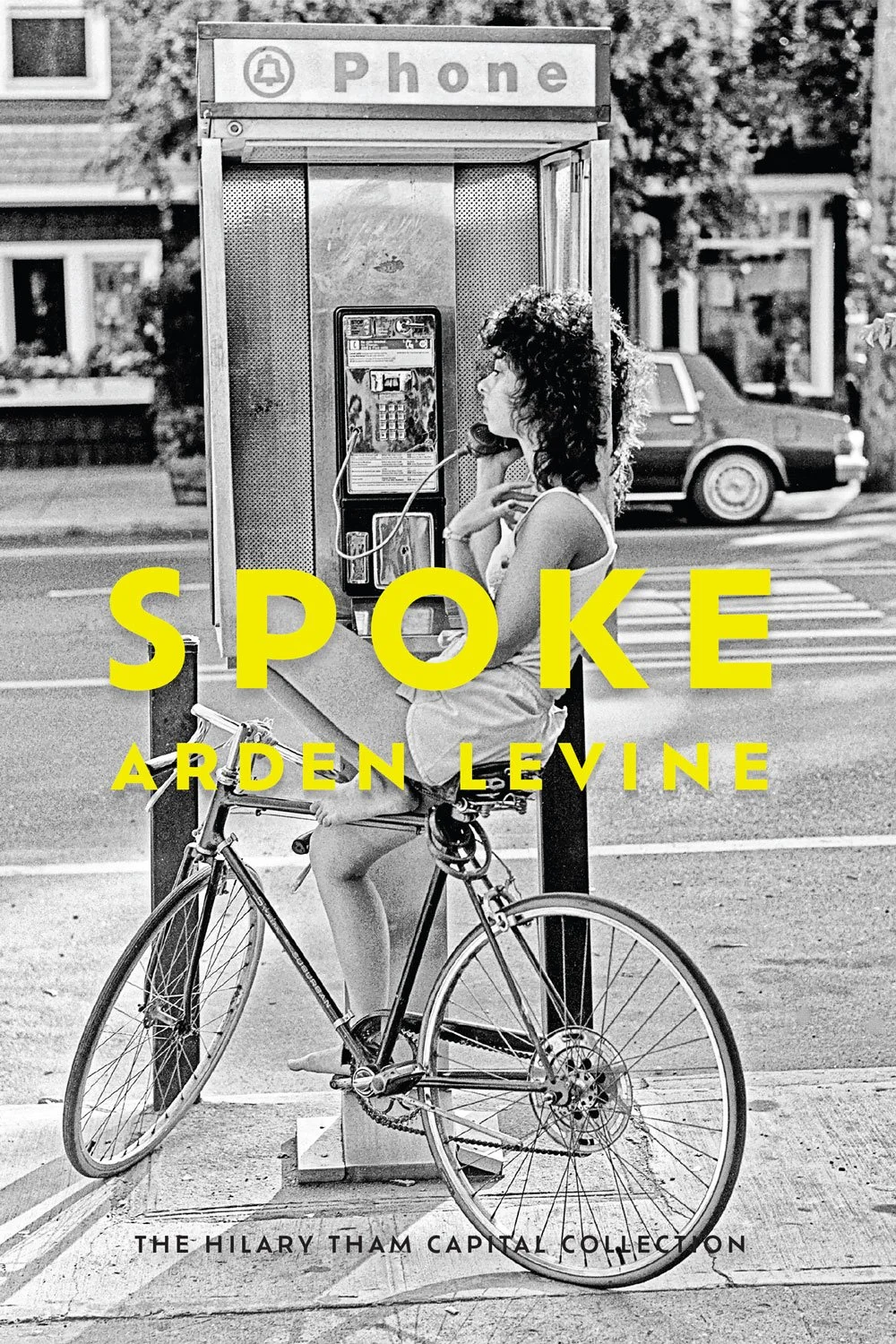
Nelson: Speaking of photography, tell us about the Ron Terner image on the cover, Girl on a Bike. For its matching of subjects and themes—and the homonym—it is perfect: we have a bike (with visible spokes) and a woman speaking on a phone. I’m curious, also, about its nostalgic atmosphere: it’s black-and-white; she’s at a payphone; the car in the background clearly from the '70s or early '80s. Do you consider Spoke as a period piece?
Levine: That Terner’s precisely correct photograph exists still feels somewhere between uncanny and impossible. I would have settled for an image that captured any, say, two of the four cardinal-point set-pieces in the book—the female body, the American city, the conveyance of language, the wheeled vehicle. All of them, though? Windfall.* And then, to your point, the fifth element as well: sociological era, or more specifically, those little aesthetic indices that a reader of a certain age will slip into like checkered Vans and over-chlorinated pool water.
Notwithstanding its Gen X-iness, though, the emo vibes and banana seats, I wouldn’t consider the book as of-a-moment. It has time stamps to be sure, but also it deliberately plays with the idea of history and time; it proposes a concept of the past as a location but not a fixed point and the future as position into which we can project the anticipation of losses that haven’t occurred. I believe that poems like “Sonnet,” “Again, Winter,” “Upon Re-entry,” “Becalm,” and “(Requiem: 2015)” tilt all the way into this here-but-nowhere / now-but-no-when intent… enough so that the reader may become disoriented as to whether the dead are yet dead, or still dead. That said, the late 20th-century artifacts give Spoke some of its purely pleasurable interludes; armband tattoos and Billy Joel show up like boardwalk popsicles, and the dead are, occasionally/gratefully, The Dead.
(*By the way: Terner lives in the same city I live in and work for; he has been operating his same Bronx art gallery, Focal Point, for the same fifty-two years that The Word Works has been publishing poetry collections; said gallery is down a block from the location where this photo was taken; and he’s still in touch with the “girl” in the photo. [Hi, Diane!] You can’t make this stuff up.)
Nelson: I like the recurring man, or men, who appear in brackets: “[a man].” I read them as a former lover or lovers. There’s a real pathos in these scenes of past intimacy; for example, the brilliantly understated moment when [a man] bakes the speaker a pie as their relationship ends, and we don’t know exactly why he’s covering his face. But this is to say I like how much you take on—or let in—in Spoke. There’s a complex relationship with father; there’s intimacy experienced and lost; there are moments of friendship; there’s the city; there’s death—and it all coheres. Speak if you will about cohesion and through lines.
Levine: At the risk of over-invoking photography (not possible!): Susan Sontag, in the first essay of her collection On Photography, describes photos as providing “narrowly selective transparency…a pseudo-presence and a token of absence”; it’s a recognition that the art engages in storytelling, but also storyhiding, storyfolding, and storyfoxing. Given the themes of abandonment, omission, and (r)egression in Spoke, this concept tracks. (Pun regrettably intended.) You mention the “[man]” that keeps showing up. The book stays mum on whether he represents one man containing multitudes or many indistinguishable men… but, by the end, that answer may not matter: the man/men are mutable (in both senses of the word); they exist mostly as shapes,* as spokes, and only when the girl/woman at the center of the poems directs light at them do we come to know those shapes by the length of their shadows.
All to say, if there’s a cohering theme, it’s the loving, tensile human bond with absence and impermanence: the gift box with an anonymous object of adoration (“Discomfit”), the apartment inhabited by a (real or imagined?) familiar presence (“Remaining Evidence”), the cities that get traded in for other cities (“Dupont Circle,” “Cages”), the woman in solitude vectored to both her bed and the sky by roof beams and moonbeams (“Construct”). And if there’s a through line, it’s the speaker of these poems: she’s our Beatrice-as-bike-courier, hauling the message of passion and grief across every dark causeway to the terminal station.
(*By the way again: I recently learned that if a wheel’s rim is segmented, the sections are called “felloes.” You can’t make this stuff up either.)
Nelson: And about that third epigraph—without actually giving away what it is, I’ll mention that I’m a big Tori Amos fan. And I find these lines from “Cornflake Girl” are also relevant: “And the man with the golden gun / Thinks he knows so much.”
Levine: Oh, let’s bring it all the way back around, then… Besides the fact that the B-side to the U.K. single for “Cornflake Girl” was a cover of a Joni Mitchell song (and the first poem in Spoke also “covers” a Joni Mitchell song), those lines in "Cornflake Girl," which are the front half of the song's bridge, were sung by Merry Clayton; Clayton also sung the iconic broken-scream bridge of the Rolling Stones’ “Gimme Shelter” (“rape, murder; it’s just a shot away”) and experienced a tragic aftermath. The back half of the bridge of “Cornflake Girl” is sung by Amos herself: “Rabbit, where’d you put the keys, girl?” And here’s the thing: both songs contemplate the thin margins between harm and protection, fear and cover, the break and the path paved over the break. A gunshot opens a hole, and a key opens everything else. If Spoke had a bridge, I’d want Clayton on vocals and Amos on piano.