A Review of Brenda Hillman’s Still House in the Desert: An Eco-Contemplation — December 1, 2026 by Nancy Doyle
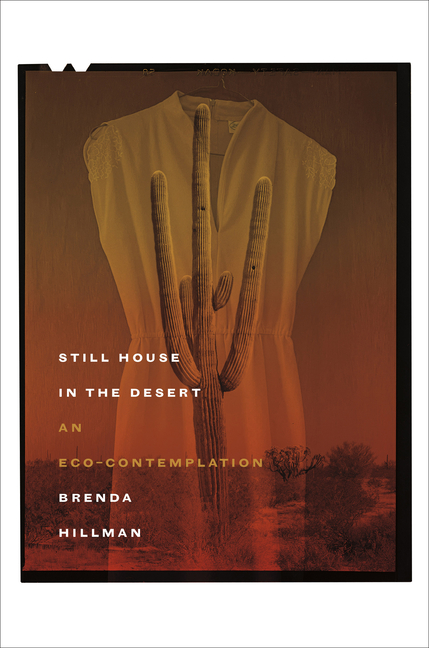
In Still House in the Desert, text and photos of common things from a particular time of American childhood appear side-by-side: a porcelain-faced cookie jar, sliding glass doors, clip-on earrings, Sugar Pops and Minute Rice, the vacuum cleaner, a chessboard. The title itself suggests something direct and simple. It is a “still” house. The book cover’s layered photo of cactus, a dress, and the Sonoran Desert encourage a calm state of mind. But don’t be deceived. Hillman wants to put us in our place, literally and figuratively, and her words and visions on the page explode outward from the Arizona house in which she grew up into scientific, ecological, and political realms. We find ourselves amid historical and homely ephemera, suddenly invited to consider cosmic time travel because the books in that small house rest on “shelves with ancient dust made before the sun,” and the old familiar stapler is made of metal “from stars so long ago.”
Like the atoms whose electrons “move faster than bodies move,” these three realms come together and apart repeatedly throughout the collection. The connections and disconnections between them force us to continually reconsider our personal vantage points: our own childhood, our understanding of the scientific world, our own distinctly American histories.
The poem “1951,” for example, begins with the question: “Was it odd to be born?” Was it? She’s asking us, and for readers born around that time, there are hints in the poem that, in fact, yes, it was very odd: We are lying down in a Chevy at the drive-in movies while pesticides seem harmless and nuclear testing is beginning. All the poems in the section titled The Years do something similar; they ask us to remember, to jump back in, and then to reflect on how to make sense of a very particular time and place in which we grew up. In “1968” the Beatles, “the four boys,” arrive “in bright colors,” but also “Jackie’s Chanel suit / spattered with blood, six gold / buttons.”
By the time we get to “1970” and “1971,” we, especially those of us have lived through those years, have experienced enough history, personal and political, to hear the challenge when she writes, “The war the war. The marches / change nothing.” She wonders: “Was it odd to be born?” Isn’t it odd? Isn’t it as true today as it ever was? If so, what exactly might we conclude about our own memories, our own lives?
Keep reading! In a later section, The Processes, are pieces specifically labelled “Documentary poetics.” Here the poet’s voice becomes calm and clear as she weaves together complicated reflections on her own mother’s life. Near the end of a long lyric piece, she realizes that the attempt to tell the story of what happened in the past will not and cannot match the way another person will tell it: “Decades later, when she talks to her mother, the poor mother says, That’s not what / happened & the daughter says, That is what happened.” And then Hillman offers this sobering comment: “Such efforts / at truth are brave but truth cannot be known.”
As readers we can leave where we are in time and place and follow Hillman for a few moments to stand with her and bravely name our memories. If she is right and the truth cannot be known, then both hers and our own memories are simply the bravest way we know how to remember them. That’s all they mean and that’s all they are. Like her, after we remember where we have lived, the life we have lived, the rooms and the objects of memory, we can be brave and decide for ourselves.
From another writer’s pen, this time travel and the task of braiding time and matter into our own histories might be so overwhelming, so ponderous, as to render us mute and frozen, but Hillman’s poetry often takes twists and turns, inviting the reader to make sense of things beyond what they are or where they are set in historical record. This is not new: in an earlier book, Loose Sugar, she similarly put together memories of the Vietnam draft years, Chevron oil tankers, and brush fires in Los Angeles. In that collection, she named one of the poems, “deep noticing,” which is clearly what she repeatedly asks readers to do. What’s new in Still House in the Desert is the intensity and detail of what we are to notice. “The Repetitions,” a twenty-one page homage to her mother’s life, has multiple photos of handiwork, family, notes, and objects scattered throughout. There are unfinished embroideries and crocheted potholders, formal ancestor portraits, a dustpan, a mounted butterfly. We have to take a breath now and then to get through it. And then, at the end, “We repeat because we love the world. We repeat until we are free.” Again, what a perspective she asks us to take! We matter, just as we are in this unfolding reminiscence. Bravery and love.
And yet, as serious as the subjects are, Hillman finds a way to lighten them, to pull us in. We can enjoy her use of word play (“We found the started vests with yarn like tangled / dangled phrases. We found the rest. Don’t tell / a yarn about this”) and her odd punctuation forms, though maybe you must see how those dots, commas, parentheses, etc. land on page to truly enjoy their weirdness. We can chuckle and wonder at the strange poem title, “Childhood Eternity During Science Class Fragment” and then are brought back to earth at the opening line: “The child opened the science book.” Of course she did. This is Hillman’s best trick: setting up a challenging line and then reminding us to not take ourselves so seriously.
This call to remember carefully and reflect, while at the same time getting out of our own head, is well-expressed in “The Made Thing Thinks of You,” a long, meditative poem that forms itself around useful objects in the midcentury kitchen and wonders about the role of electrons in all these various things. It ends with her thrifty mother’s reminder to save everything, followed immediately and ending with, “Your love / lights the world.” There is a brave remembering. Let’s call it truth.