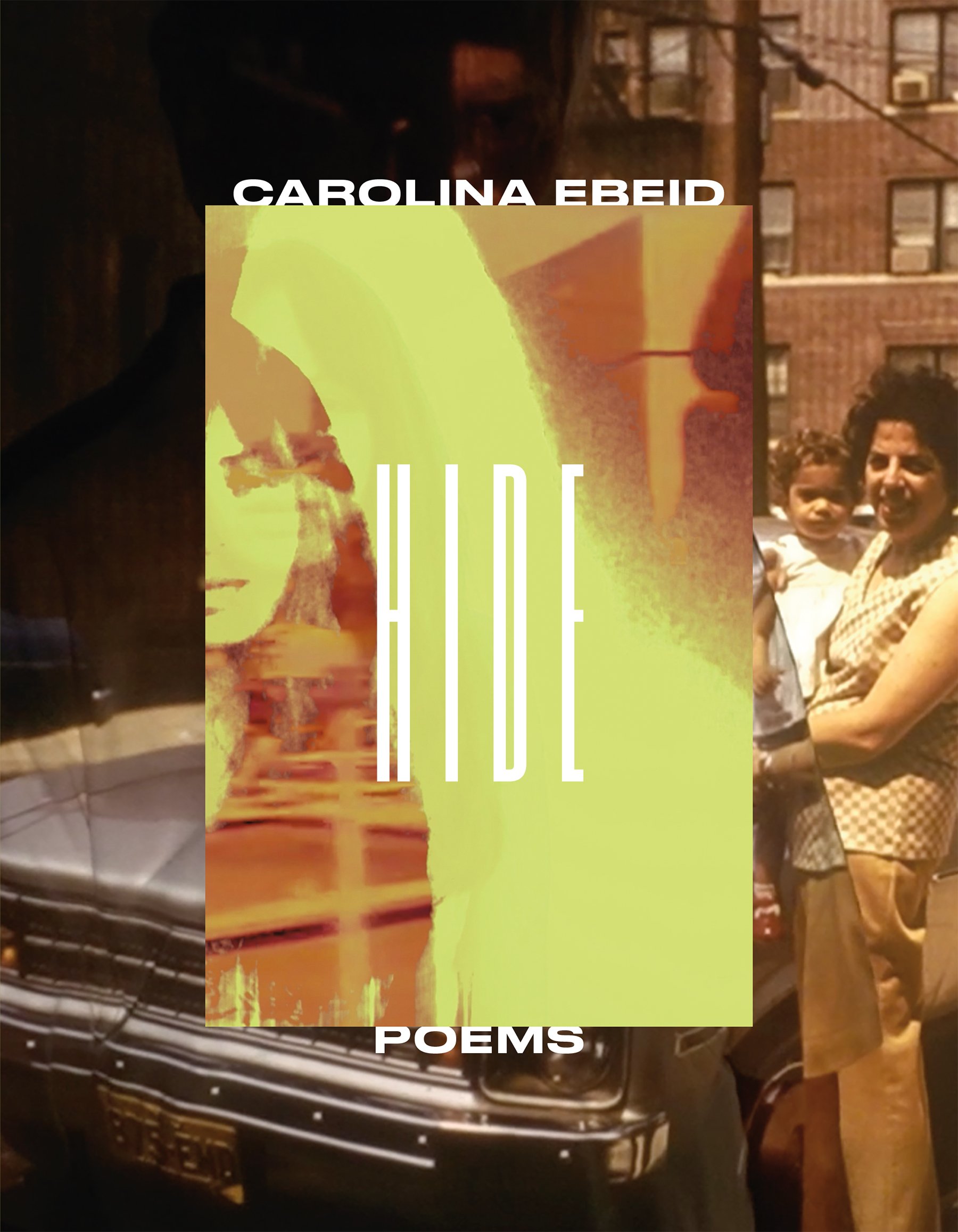
Imagine this review is recorded on a cassette. Imagine the sound of the magnetic tape being wound into both past and future. Imagine my voice, analog. Imagine my words becoming matter. Now you are ready to enter Hide, Carolina Ebeid’s second poetry collection, which immerses the reader into the exploration of “memory / mostly touchable,” like skin, like a hide.
The first of four sections explores the speaker’s memory of her family between Palestine, Iraq, Cuba, and the United States. It is a memory marked by movements, as the section title “M is a Pictograph of Waves” suggests. The section follows the threads of displacement but also of matrilineal persistence woven in the familial fabric, like weft and warp, like the “M of low-hummed migrations” and “the M of movement in miles of mother of ancestral mitochondria.” Against forced unmoorings, the poems reveal an embrace of movement through the metaphor of the sea as guiding matrilineal waves: “M del mare, M de la madre,” “Maria / Mare, Mary / ... / Miriam / Measure the sound particles of water falling on water.” The sea, the water, seems to represent what the speaker can always return to. When the last poem of the section evokes the arrival into a new homeland filled with fear, shyness, and disappointment, the instinct or recourse indeed becomes: “(you drink the water).” Palliating the losses of displacement, “the sea [i.e., the matrilineal waves] is more.”
In an interesting mise en abyme, this tension between displacement and persistence echoes that of memory itself, reflected in the “elsewhere of photographs” and the “hereness of a photo.” The many photographs, videos, recorded words, and sounds “hidden in the cochlea” that prompt and pervade the poems, moor memory into a tangible present. However, they also point to the displacement that memory is. As the speaker affirms in one poem: “black magnetic tape holding voices, also a measurable distance.” In an act of reminiscence, the speaker investigates elements from a lived, distant past that she might be able to decipher and reinterpret in the present. These elements comprise audio and visual texts that constitute, somehow, the text-ure of memory, its tangible aspects that persist through time.
In Ebeid’s collection, this texture appears to have an epidermal quality. Like skin or a hide, it has recorded life on its surface. It wears wounds and scars. It has been worn and corrupted by time. It could be understood with the characteristic of a scroll in mind: “before it was writing surface, it was living skin.” In her seminal preface to Stigmata, entitled “Stigmatexts,” Hélène Cixous considers literature from a similar epidermal point of view and explains that “the stigma is a scar that is difficult to efface. The stigma resists being worn down, The hole enters into [one’s] skin. The scar adds, the stigma digs, excavates.” (xiv). However, Cixous sees this stigma as a sign of fertilization or germination, rather than destruction. As she puts it, “in the cavity, resurrection is hatched” (xiv). The speaker of Hide excavates a familial history of displacement. As if following Adorno’s injunction mentioned in the poem “Psychogeography,” the collection seems indeed to “cultivate a sense of displacement in the world” (Ebeid 29). This cultivation of displacement, this stigma, can open the possibility for creation, for fertilization of the family story, for “an elsewhere where corpses begin to flower.”
The stigma of displacement seems to operate at the level of language and time as well. The family story emerges as “disarticulated” and what remains are mainly sounds: “the movie theater’s Arabic revoicings,” the “click-click” of heels, a “voice recording,” “the shred part of [a] voice,” a mother’s laughter, “sound particles,” “vowels ris[ing] from the glottal place / of the throat,” “the neon voice of English words,” etc. These sounds germinate into poems of familial resonance, or fertilize back into matrilineal sound drifts as in “Dream of Saint Mary of Egypt” and “Disambiguation of Miriam,” from which these lines are excerpted:
lither earth whelp u lied ears shut in years n’t years n’t
Time also undergoes a movement of both disarticulation and conflation, under the sign of Janus, the double-faced god who can simultaneously look towards past and future. The poems in Hide constantly navigate this temporal tension, this displacement, as one line from the poem “Scripts for the Future” exemplifies: “you will [future] all have gone by then [past].” However, Janus is also the god of endings and new beginnings, and the 1st of January (Janus’ month), appearing twice in the collection, points again towards possible resurrection and renewal.
The second section, “Devil Thread,” moves away from the familial story to poems that invoke the art and life of the Cuban-American artist Ana Mendieta. This move seems organic, as if Ana Mendieta was part of the waves of female figures who have carried and influenced the speaker. The two last lines of the first poem suggest this connection: “Network of radio waves between us passing / back and forth sensitive information.” Mendieta’s earth body work, performances, and films, which inspired this section, echo the textural memory of the first section. The poems could also be seen as “stigmatexts,” as they consider Mendieta’s excavating work of the female body, in particular through her “siluetas.” In “Autochtonous Silueta,” Ebeid points at Mendieta’s literal “concave dug-out of herself” and at the displacement of female bodies: “Mud is never / muted never without a mouth for / displaced people.” This displacement can be seen in the demonization of the female body as well, that Mendieta denounced in her performanceBlood Sign No 1. Ebeid evokes this performance in the strikingly visual poem “Blood Sign” and in the poem “There Is a Devil Inside Me,” which is the sentence Mendieta wrote with blood during the performance.
The displacement of the female body culminates in the literal displacement of Mendieta’s death—a fall from a 34th floor window. Her husband was suspected to have pushed her out of the window during an altercation but was subsequently acquitted. As if trying to make sense of the act, three poems excavate the fall again and again, its physical and domestic violence: “Night Became a Long Volta,” “Gasp,” and “Weight.” Ebeid excels at spinning the fall on its axis, creating a dizzying sense of gravity, and then leaving the reader only with deafening silence—the white space—that struck after the fall: “Isn’t white / space the white human teeth glossed / with blood on the concrete?” However, the trajectory of Ana Mendieta’s body traces a line through this white space, a “line like a cut sewn up, a rupture stitched”—a bloodline through which her work persists, continues to fertilize present and future.
The third section, “Dauerwunder,” offers another exploration into lineage and the work of memory, opening with a quote by another poet, Brandon Shimoda: “Where do the ancestors gather?” An answer is hinted by an event related at the beginning of the section. As the speaker and her son use a computer to translate words from English to Arabic, a glitch happens, “a sudden marketplace of voices” surges. This uncanny event prompts the speaker to wonder: “can we say [the ancestors] find a slit or tear in the digital universe to speak through us?” The section keeps on investigating the miraculous yet fragmentary aspects of memory, illustrated by the title. The German word “Dauerwunder,” the poet tells us in her notes, is a religious term meaning “enduring miracle.” She associates it “with reliquaries that hold biological matter (fragments) of saints” and with the fragments of her notational thinking that generated the section. These fragments span across time (antiquity and contemporary), space (Gaza and the West Bank, Aleppo, Hiroshima, Denver), art (movie, paintings) and literature.
This third section explores in particular the link between memory, grief, and mourning, suggested by the various iterations of the funerary shroud: “her dress like a casket,” “pall (n.) perhaps from pellis, skin / altar cloth, coffin cover,” “that green great Greek grief skin on skin,” “the future shroud enveloping the head.” One can also think of a shroud as a hide—the epidermal remains of an ancestor, and as the fabric of memory. The question of what persists through time, emerges again. The speaker asks “will the cloth / transmit the traces of what / happened before,” or “how much of my mother’s skin in microparticles remains on her necklace I’m wearing.” Memory, even fragmentary or inaccurate, appears as a way for the speaker to mourn and to connect with the lineage of women she belongs to. It appears as a way to fertilize death, like the stigma, the “Tomb-cradle” expressed by Cixous.
The final section is a single poem titled “Transgrace,” which looks like a root system, with each tendril quoting the same title of a musical composition: “Gone Through the Veil—Becoming a Swan.” If its simplicity seems to distill the essence of the collection, the poem could also be seen as the last stage of mourning––when the displaced seeds germinate, when through transformation, transgression, fertilization, the tendrils of love and grief sprout into grace. Ebeid’s collection is a magnificent homage to all the displaced and to the women in her biological, historical, geographical, and artistic lineage. It is an exceptional work of poetry that touches the skin of memory, “run [its] hand along the sharpest edge of it,” and transgrace its scars and wounds into life. In this sense, it could be read as Cixous’ stigmatext, where stigma is a pistil that will foster new life (xiv). With Hide, Ebeid demonstrates she is among the most inventive, complex, and intriguing poets currently writing.