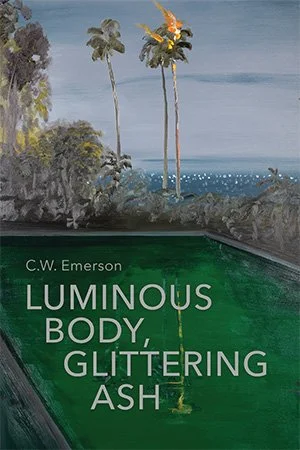
A Review of C.W. Emerson’s Luminous Body, Glittering Ash — January 15, 2026 by José Enrique Medina
I didn’t expect to be afraid of this book.
Halfway through Luminous Body, Glittering Ash, I noticed I was reading more slowly than usual. Not because the poems were difficult, but because I knew what was coming and didn’t want to arrive there yet. I was stalling. That kind of hesitation is rare. Most AIDS-era poetry tells you early what it’s about. It prepares you. C.W. Emerson doesn’t. He lets you fall in love with the world first.
The early poems are full of bodies, light, youth, desire. They feel open, almost carefree. Loss doesn’t enter with an announcement. It seeps in. Someone disappears. A body changes. An absence begins to press. By the time you understand what kind of book you’re reading, you’re already inside it. That delay feels painfully accurate to the history itself, the way the plague moved first as rumor, then symptom, then silence, long before it had a name.
The power of this book comes from what it refuses to do. It doesn’t dramatize grief or ask for admiration. When Emerson writes, “I was falling in love with the world, and everything in the world was dying,” the line isn’t dressed up. It doesn’t lean on irony or lyric flourish. It just tells the truth and leaves it there. Later comes, “I was twenty-two and already old.” I had to stop reading when I reached that sentence. Not because it was beautiful, but because it felt exact. Youth lived under a shortened horizon, stated plainly, without pity.
The book’s structure matters. Part I, LUMINOUS BODY, carries desire, memory, and physical pleasure. Part II, ASH, moves into caregiving, depletion, and the long aftermath of having survived. The shift isn’t abrupt. It’s unavoidable. By the time poems like “Joe,” “Neighborhood Watch,” “Darkling,” and “My Father’s Death” appear, the book has done the work to support them. They don’t ask for attention. They receive it.
Emerson’s longer poems are especially strong. “The Impossible Time” and “Coldwater Canyon Suite” hold narrative without slipping into memoir or losing lyric tension, which is harder than it looks. One line stays with me: “There would be no future, so we made no plans.” That sentence captures something many of us know but rarely see named—the strange suspension of time during the epidemic, the way life narrowed to the present even as loss kept accelerating.
Again and again, the poems return to the body. Not an idealized body, and not only a suffering one, but a stubborn, compromised body that keeps insisting on life. “The body wants to live” becomes a refrain, and what matters is that the poems don’t argue with it. Not when living grows exhausting. Not when care becomes labor. Not when survival feels morally complicated rather than heroic.
What sets Luminous Body, Glittering Ash apart from much AIDS-era witness poetry is its patience. Emerson doesn’t turn suffering into spectacle. He stays with moments other writers might rush past or try to elevate. The authority of this book comes from endurance, from attention held over time, not from resolution or uplift.
When I finished the book, I didn’t feel consoled. I felt entrusted. As if I’d been handed something that had been carried carefully for many years and asked not to mishandle it. This is a book for readers who understand that witness is work, that survival is not the same as triumph, and that some histories can only be told by a voice steady enough to hold them.