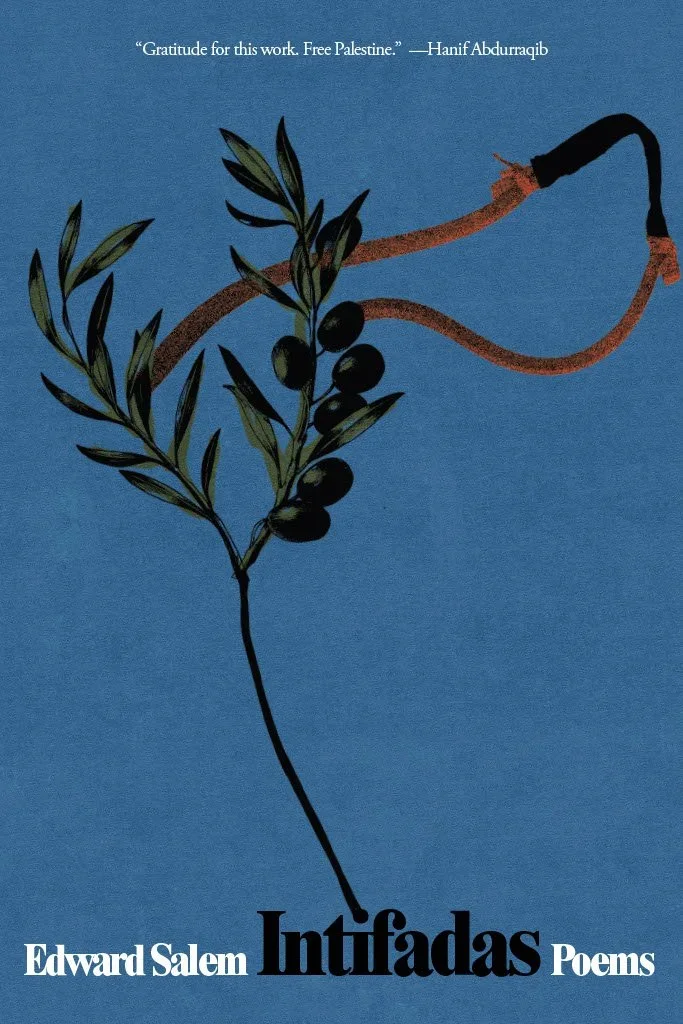
A review of Edward Salem’s Intifadas — April 3, 2026 by Christopher Nelson
We need iconoclastic poets right now. We need their hammers to break what we’ve come to expect and what we’ve neglected to question. Edward Salem’s Intifadas (Sarabande, 2026) is a hammer against the iconography of empire and the lawlessness of official party lines; it is a golden, singing, self-doubting hammer.
Mission
The dead Palestinian brother. I have lost each of you, my personal friend and sister and glass of cold water.
My firm hand gropes for frozen rocks in the night. I just want to sleep.
In the nightmare, I slap your dead foreheads with my blue and gold passport.
Intifadas is a difficult book, not because of rhetorical or formal complexity, for in these ways it is straightforward: brief, image-driven narratives about a genocide. Genocide makes it difficult, but it also makes it urgent, captivating, and damning. When you open its pages, you will read about terrible transgressions and heart-wrenching accounts of loss—the loss of everything: family, home, body parts, work, sanity, country. Salem—a Palestinian-American—brilliantly puts himself at the center of the nightmare so that the poems are an enactment of trying to remain human amidst great inhumanity. And admirably he embraces his fallibility. In these poems are mistakes, weaknesses, unknowing, and the “lesser,” base emotions of wrath and lust. A conceptual artist and filmmaker, he describes in “Stack Drop” a two-foot-tall manuscript he wrote called The Third Intifada that he dropped from a roof and had his friend film: “the paper was supposed to / scatter chaotically like soldiers parachuting in high wind,” but it falls “like an anvil” and breaks the cameraman’s hand.
Subversive in Intifadas is an undercurrent of humor. While dark, admittedly, finding reason to laugh during a murderous catastrophe is a kind of power, a kind of wisdom that acknowledges and counters our seemingly bottomless capacity for folly. He writes, “No one tells you your asshole will sting / in the Dead Sea.” Isn’t humor the oldest irony? The cover image by Arsh Raziuddin embodies a complex irony perfectly illustrative of this book: a thin olive branch—traditional symbol of peace—is converted into a slingshot, but it is such a frail version of an already minor weapon that it evokes more pity than meaningful defiance…apparently. That Salem’s ironic humor is impotent to change anything matters little; it’s point, one could argue, is to preserve, not change: to preserve the humanity in the writer and the reader. And this may be the book’s best gift, though one of many.
Evidence of Salem’s unflappable humanity is especially haunting in the poem “Mortificatio,” where we read the refrain, “I wonder who the Palestinians will commit genocide against / after the world saves them from their own genocide.” Why do I call this evidence of humanity and not cynicism? A cynic is a realist without imagination, but a humanist knows that we are capable of anything—a promise of great lightness and great darkness. In Intifadas Salem accomplishes the very difficult: to balance the scales of our human potentials, and at that, readers will marvel.