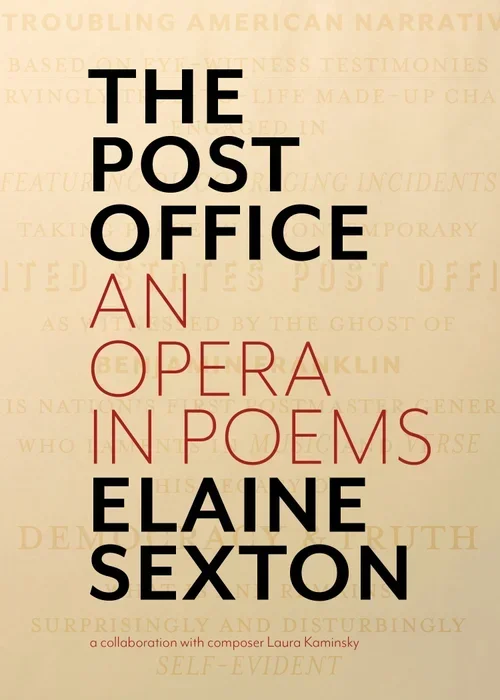
A review of Elaine Sexton’s The Post Office: An Opera in Poems — June 20, 2026 by Elizabeth Coletti
Between the verses of Elaine Sexton’s The Post Office: An Opera in Poems, full-page photos take the reader on a tour of post offices across the United States. Rows of stone columns, tidy brick walls, and the familiar blue of USPS mail collection boxes: these sights are nothing new, reminiscent of buildings the reader has likely visited to send a package, pick up a passport, or deliver a ballot, and in that they belie the churn and gravity of an institution that carries out the foundational operations of a community.
The same can be said of Sexton’s poetry collection: an orderly package on the surface that, once you accept the invitation to enter through its open door, unearths struggles over truth and justice core to the postal service and the relationships within, conflicts that play out every day between friends and colleagues as all attempt to navigate the politically and socially contentious present moment. The collection’s form—an opera in poems created in collaboration between Sexton and composer Laura Kaminsky—forefronts the essential juxtaposition of something so banal as the mail also being a pillar of our government that deserves the heraldry and dramatic fervor of an opera.
The Post Office centers on a dispute over gay marriage and free speech in a government workplace that escalates between the postmaster Ben, who is Black and deeply religious, and the senior postal clerk Frank, a white and gay man, when the latter announces his upcoming wedding. The opera takes place within the single room of the post office, a humble and prosaic setting that lends a sense of claustrophobia to the brewing conflict. These characters serve as mouthpieces at an institutional bedrock, and their “words matter.”
The syntax is methodical, full of direct addresses and declarations to rival Thomas Jefferson’s. Characters implore each other and the audience to accept them, their beliefs, and their humanity, much in the way that, in order to function, the post office must be “a shared and public space that delivers and accepts the mail (and what it carries) without judgment,” as recorded in the character description of the Post Office, which serves as the operatic ensemble, a personified voice for democracy and its self-evident tenants. Yet as the poems probe what is truly self-evident, friction builds and the idealistic foundations of the post office fracture. In “Every Day I Wake with Dread,” a postal worker laments, “This post office is toxic. And America? The same? / Who am I to judge? / Who am I to believe?” Spare phrasing invites multiple understandings, each person afraid to judge and be judged, uncertain who to believe or who could believe them if they sought to be seen and accepted.
The debate reaches a crescendo with “What You Think,” a polyphony of the characters crying out with the refrain “I’m not what you think.” Lines echo and invert each other, invoking racial and class divides as the two men dismantle their friendship. Ben refuses to believe his marriage and Frank’s are the same, while Frank argues for his rights to speak freely. Two other voices add their perspectives. Customer Emily is married to a woman despite not believing in the institution. Her verses bounce off those of part-time postal clerk Anna, who struggles financially and is swayed by Make America Great Again rhetoric, which leads her to feel more isolated and judged. She sings, “All I see in the future is me, losing, losing,” reflecting the discord and despair of the ensemble who cannot manage to find common, self-evident ground even within the stabilizing force of the post office.
Amid this fray, Sexton conjures Benjamin Franklin, the nation’s first postmaster general and the Founding Father who “changed the word / ‘sacred’ to be / ‘self-evident’” in an attempt to preserve separation of church and state. The ghost of Benjamin Franklin appears to assess his own failings and examine the cracks threading through the institutions he helped found without resolving the flaws in the experiment. “I fought for abolition, but left this / abomination on the table. / I’m flawed. / I’m history,” he admits. Benjamin Franklin recounts his dreams and intentions for America, beseeching his contemporary counterparts to find hope attached to these ideals:
Democracy. Now dead, still beautiful? The post office—civility, decency, equality, respect. All dead. Still beautiful?
Along with the investigation of the Declaration of Independence’s “self-evident” truths, Walt Whitman’s famous line “I contain multitudes” runs through the opera, invoking the messy, diverse face of America as a country large enough to encompass the varied opinions and identities included in The Post Office. With this inclusion, Sexton grapples with pluralism as a path forward through conflict, yet she acknowledges the difficulty of finding peace within a system that also contains systemic discrimination. To Benjamin Franklin’s plea to recover the beauty of democracy, Ben’s response, in the collection’s penultimate poem, is a pained, “Beautiful? The law? / The law has never been my friend.”
In the same poem, “Nothing Personal,” Ben and Frank take down the pictures of each other’s spouses from the post office walls, declaring, “All or nothing. / Nothing personal. / Equal : : Equal.” The Post Office offers little other resolution to the country’s ongoing conflicts beyond regression to mutual exclusion. As the characters have floundered in finding any real self-evident, universally agreed-upon truths, political argument becomes a race to the bottom where neither personal testimony nor factual evidence are self-evident enough, so everything is stripped away until the bare bricks of daily institutions present themselves as ammunition to continue the fight. Sexton thus offers a hauntingly precise repudiation of modern discourse and political weaponization that metabolizes the very foundations of our nation.
In the weeks before Sexton’s collection was released, the current presidential administration dropped its own publication: an executive order that seems designed to tamper with upcoming elections by restricting mail-in voting, threatening to disenfranchise those who depend on mail-in and absentee ballots to make their voices heard in our democracy. The executive order requires USPS workers to refuse to deliver ballots from voters not included on a federal list. Yet again, the postal service is a battleground of democracy, and the post offices pictured throughout The Post Office, from Shumway, Illinois, to Jamaica, New York, to San Roque, California, are not only cogs in the daily machinery of how our country runs but witnesses to the practice of equality and justice, working to fulfill the promise: “the mail / will get where it is expected to go, / your votes, your passion, compassion, / will get where they are expected / to go.”