A review of Harryette Mullen’s Regaining Unconsciousness — August 1, 2026 by Beth Brown Preston
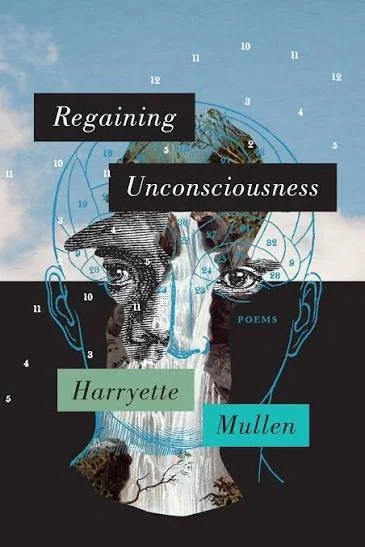
Regaining Unconsciousness is Harryette Mullen's first full-length collection to appear in thirteen years. In this new volume, she continues her fluid use of inventive language and formal experimentation to confront urgent contemporary issues like climate change, corporate domination, police violence, artificial intelligence, environmental pollution, racism, and the widening conflict and gap between individualism and the needs of the community. Yet she maintains a surprising playful and humorous tone that counteracts our complacency and sounds an alarm for the future. Her style uses inventive language play, witticisms, and experimentation with form. Her imagery is visceral and presented in layered language that resists easy interpretation while approaching difficult subject matter with levity and a wry sense of humor.
On the back cover, the reader finds commentary by Terrance Hayes, Evie Shockley, Douglas Kearney, and Monica Youn, the poet's peers in the field of literature and her fervent admirers. Youn writes, "We see her maneuver through the perilous atmospheres of this late-capitalist landscape, slipping between deadly downdrafts, surfing riptides and red tides...while, in the cities, sparks fly from block to block."
The collection builds upon earlier explorations as material for reinvention. Regaining Unconsciousness revisits Mullen's last full-length collection Urban Tumbleweed: Notes from a Tanka Diary (2012). With elements of Urban Tumbleweed's transitory yet sustained meditations, combined with the outright language play of Recyclopedia (2006), this new collection employs linguistic tropes prevalent during the COVID-19 pandemic—the language of lockdowns and misinformation—while detailing the social effects of the use of that language. In a prose poem, "Havana Syndrome," Mullen describes the effect of a mysterious undiagnosed disease on the language of the persona: “Intelligent investigators find no one to blame. Their thorough inquiry reveals no credible evidence of harmful intent or neglect. Their painstaking analysis can determine no external cause for your incoherent symptoms.” The poem imitates the voice of an authoritarian media attempting to diagnose the symptoms of the illnesses suffered by an ailing society. Still her poems insist on the survival of pleasure and on language's ability to renew and restore memory despite the recent censorship of certain American literatures.
Regaining Unconsciousness is divided into eleven sections that are held together by the perception of a more human connection. In "As I Wander Lonely in the Cloud," Mullen describes the exigencies of her creative process as she attempts to rehumanize what has been lost to the technological constraints of our language: “The cloud's vast, expanding, and indefinite memory stores all the information I create in my interlinked communications, including what I'm writing to You now, as on my couch I multitask in pensive mood, opening my mail to find a discount coupon reminding me that nothing says spring like daffodils.” And here Mullen also describes a key dilemma of our times: "Smart machines armed with proprietary algorithms remain attentive to my wishes. They use a little known, mysterious mental faculty to anticipate my urges. Ingenious applications of intelligence solve the problem of desire."
In her criticism of technology, Mullen invokes the poet William Wordsworth, the voice of Romanticism, a movement in response to the Industrial Revolution and the Age of Enlightenment. Wordsworth's work also reflected his love of nature and the humanizing effect of natural beauty on mankind. Mullen's poetics open the possibility of the pleasures and beauties of language—despite her descriptions of mass shootings, police violence, environmental disasters, and the affront on civil rights. She dismantles the language of consumer culture to expose the gendered, racialized, and environmental violence implicit in modern consumption, while employing a range of forms—the prose poem, concrete poem, rhymed couplets, free verse, and the sonnet.
Mullen was born in Florence, Alabama, in 1953, and spent most of her childhood in Fort Worth, Texas. She began to write at a young age and published her first poem while she was in high school. She earned a BA at the University of Texas in Austin and a PhD from the University of California at Santa Cruz while writing a dissertation on slave narratives. She wrote and published four collections before the appearance of Sleeping with the Dictionary (2002), in which she began to display the structurally avant-garde turn of her poetics. Sleeping with the Dictionary was nominated for the National Book Award, the National Book Critics Circle Award, and the Los Angeles Times Book Award.
Carol Muske-Dukes once commented on Mullen's poetry in the Los Angeles Times Book Review: "poetic expression here springs from a formal device, a game, a premeditated romp; a little like the Muse playing Scrabble." Then and now, Mullen's art reconstructs, redefines, and recreates, by reconnecting pieces of meaning in language. Mullen has invented her own form of lyric poetry—bluesy, disjointed, combining her concern about political issues with a postmodern structuralist development of language.
Mullen structures Regaining Unconsciousness with 111 poems divided into eleven sections, each section with its own internal coherence. She includes free verse, prose poetry, and adaptations of the ghazal, sonnet, haiku, and visual poetry mixed with fragments of popular music, folklore, and the media at "the intersection of orality and literacy"—writing both for the ear as well as the eye. Mullen describes her intention in Regaining Unconsciousness as suggesting "a recurring dream, or the possibility of dreaming within a dream."
Mullen remains one of contemporary poetry's most vocal artists with her inventive language play, biting wit, formal experimentation, and with a critique of American society. She intends to awaken her readers out of complicity and despair for the future: "Can we, even still," writes her publisher, "find our way to our unconscious selves, beyond our capacity to harm, subdue, and consume?" Mullen imagines a coming apocalypse, yet in a language that is playful, wry, funny, and readable. As the poet Elizabeth Alexander has said: "We encounter each other in words, words spiny or smooth, whispered or declaimed, words to consider, reconsider."