Westbrae Literary Group, 2026
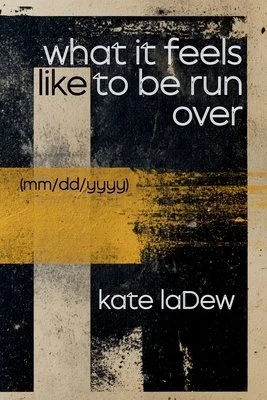
Interview with Kate LaDew on what it feels like to be run over — November 1, 2026
Kate LaDew is a poet, fiction writer, and visual artist with a BA in Studio Arts. Her work explores women’s histories, civil rights, and underrepresented historical figures. LaDew lives in Graham, North Carolina, with her cats, James Cagney and Janis Joplin. Her personal reading and research spans archival fiction, history, documenting old cemeteries, sketching and origami. Her poetry and prose has appeared in journals such as EVENT, The Maynard, Sonic Boom, and Under a Warm Green Linden.
Christopher Nelson: Congratulations on the publication of what it feels like to be run over. Let's start by talking about the book's fascinating structure: each title is a year, and we move linearly (with the exception of the first poem, which I read as a kind of frontispiece) from 712 to the present. I'm curious to hear about that formal decision and the effect that it creates of moving from historical subjects to increasingly personal.
Kate LaDew: Thank you so much. The structure didn't start out as a formal decision. I simply enjoy writing about history, those strange, obscure moments that speak to a larger truth. As I assembled the collection, I realized the poems I was most proud of were tied to specific dates. There are real historical artifacts behind them that the reader can actually find. The titular poem “what it feels like to be run over,” was inspired by a short film from 1900 that you can watch online. “Orange socks” draws from a newspaper article printed on October 31, 1979. “you hold up the bible” took place on June 1, 2020, a day many readers will remember from viral videos.
When I put the poems in chronological order, the dates crossed into my own lifetime. “you bolt the windows, you bolt the doors” deals with the Covid pandemic, a crisis that affected the entire world. “I remind myself you aren't like that” is about what it feels like as a woman to explain to a man why she can’t run alone at night. Whether a poem’s about a global event or a private conversation, it’s still history. As we get older, exact dates might get fuzzy, but the feelings remain vivid. I wanted the collection to reflect that, becoming more personal as the timeline reaches past the year I was born and my own experiences join the historical record.
Nelson: You mentioned your poem “June 1, 2020,” referring, of course, to Donald Trump’s unconvincing photo-op in front of church, which was followed by his call for a crackdown on civil unrest. Between the Trump presidency and its assault on norms and civic freedoms, the Covid pandemic, three wars with U.S. involvement, a weakened economy, etc., many feel like they’ve been run over. What has writing this book been like for you in these times—cathartic, a kind of escape or deflection, a way to orient or refocus?
LaDew: Seeing everything listed out like that, well, the past six years have been a lot. I’ve had a few people tell me they picked up the book simply because they related to the title. We all feel a little flattened right now.
Writing this book, and any poem since, is certainly my way of making sense of these “interesting” times. It’s a way to get to the other side of the street. This collection in particular helped me see just how much history moves. Nothing is forever, this too shall pass. It’s a cliche, but everything dies and everybody dies.
In the poem “(the woolfs) virginia and leonard turn on the radio,” I write about the years before World War II when no one could go anywhere without hearing Hitler’s voice projected at them. He was a constant in everyone’s lives for years and years, until he wasn’t. Terrible things happened, atrocities on a scale that hadn’t been seen before. But it ended. Movements like that don’t last after the leader is gone.
Being able to write about that, and then literally turn the page to the next year and the next, was a catharsis. It was an escape but also a reminder that time just keeps on ticking. People rise and fall, they are born and they die, every single one of us, no matter how much money or power someone currently holds. In the end, we all have to decide which side we’re on: the one tripping backward, kicking and screaming, or the one moving forward with arms linked.
Nelson: There’s a great moment in that poem, “1937,” when Virginia calls Leonard to hear Hitler on the radio, and Leonard responds “I shan’t come! I’m planting tulips, / and they’ll be blooming long after that man is dead!” It’s a beautiful and inspiring moment. You don’t, however, ignore the horror of all that follows, in favor, perhaps, of optimism and romance: “prayer shawls [will be] towering in heaps” and the “bodies of men and women and little children / [will be] tangled together, filling the earth,” and, of course, Virginia will end up drowned in the River Ouse. I’ve been thinking about the role of artists in shaping the mood of a society’s future or imaginings of a future. Do you have thoughts on that? Am I ascribing too much burden or power to the artist?
LaDew: I don’t think you’re ascribing too much power, but perhaps the burden isn’t exactly what we think it is. I don’t see the artist’s job as fixing the future, or even necessarily offering comfort. Our job is just to look at the present and remember the past honestly, pointing out how they overlap, no matter how uncomfortable that makes the reader or the writer feel.
When I wrote about Leonard planting tulips while Hitler rants, I didn’t see it as him denying the horror. To me, it was an act of defiance. It’s a quiet way of saying that normal life, growing things instead of killing things, will last a lot longer than tyrants do. But if I only show the tulips and leave out the horrors of World War II or Virginia drowning in the river, then I’m lying.
Art keeps the past from being cleaned up. When someone writes about a thing in the moment and puts it out into the world, it becomes a fact that can’t be denied. If we try to gloss over those details now just to make them easier for a modern audience to hear, we’re betraying those who actually had to live through it. We can’t think about what comes next if we pretend the monsters didn’t exist or that regular people didn’t suffer. If artists have any real power, it’s just the ability to say: Look at how terrible it was, look at how beautiful it was, and look at how we’re still here. We leave a record so the generation that comes after us knows they aren’t the first ones to live through these things, and they won’t be the last.
Nelson: I enjoy the surprises of the book, not knowing what we will experience from poem to poem amid its variety of subjects. There’s a playfulness, even whimsy, to the arrangement. However, a red thread of violence weaves throughout: public execution, assassination, the young killed in war, a rape, a murder. How do you see this motif of violence within the whole? Or is it more than that: Is violence a primary subject of the book?
LaDew: Most documented historical events are violent and dramatic. It’s the in-between moments, the moments when we as people aren’t doing much of anything, that make those bursts of violence so shocking. I decided to name the collection “what it feels like to be run over” because most days are just ordinary, until they aren’t. Not a lot of poems are written about crossing the street and getting to the other side, but that’s usually what happens. The lighter poems show that safe arrival. They represent the peaceful days we take for granted. I wanted readers to feel that contrast. Placing those pieces next to the heavy ones gives a sense of what is actually being lost when bad things occur. This reflects the whole idea of the title, where you go from poem to poem, never knowing what is coming next.
Nelson: One of the book’s longer poems is about the Kennedys—the marriage of Jack and Jackie, the hope and youthfulness they embodied, and, of course, the assassination. I love—and am fascinated by—your decision to tell that story largely through the perspective of Anne Lowe, the Black designer who made Jackie’s wedding dress.
LaDew: I didn’t mean to include Ann Lowe at all, mostly because I had never heard of her. Sometimes I just scroll through old photos online looking for inspiration, and I came across one of Jack and Jackie on their wedding day. They looked almost like brother and sister, with big smiles, big brown eyes, young and impossibly beautiful.
I started looking up details about the wedding and the dress, wondering what kind of fabric it was and how long it took to make. I found a quote from Jackie at the time where she was very dismissive of the designer. She actually seemed like she didn’t particularly care for how the dress turned out, and I thought, huh, I wonder how the designer felt about that.
When I looked for news coverage from the actual wedding, the articles didn’t mention Ann’s name at all. It wasn’t until years later, after the assassination, that pieces started linking her to the dress. That’s when I found Ann. She lived through that era just like Jack and Jackie, only under completely different circumstances. She was a Black woman designing dresses for the upper crust, a world she could never truly be a part of, no matter how talented she was or how much they relied on her.
Then I started uncovering all the details. Ann’s studio flooded just days before the wedding, she remade the wedding dress and the bridesmaids’ gowns at her own expense, drove hours to deliver them, and was then told to use the service entrance. The poem wasn’t about the Kennedys anymore. It had to be about Ann. Countless stories have been written about the forever rich, but Ann was the one I couldn’t stop thinking about.
Nelson: One of many qualities I admire in your voice (style of mind) is the apparent ease, the fluidity with which you shift subjects; for example, “2023” starts off as a poem about daylight savings and becomes an empathetic consideration of the war in Ukraine. I don’t want to suggest the potential lack of cohesion that can accompany free-association writing—no, your poems cohere tightly—, but I am curious about your process, if you want to let us peek behind the curtain. Is there a lot of research, revision, filling in gaps, or is it more of a so-called “flow state,” the Dionysian outpouring?
LaDew: I had to look up what a “Dionysian outpouring” meant! But, no, that’s definitely not how it happens for me. It isn’t really a grand collision of deep ideas in my head either, though that would make it easier. The truth is, I hardly ever revise a poem. I might take a single line out here or there, but what I write down the first time is usually what stays on the page. Because of that, my process changes completely depending on the years I’m writing about. For the poems set before I was born, I do a lot of research. I look up old newspaper articles and search for images of people and places so I can actually see the subjects. I think of those poems as a form of creative nonfiction. Obviously, I can’t know exactly what someone was thinking back then or the exact words they used, but I try to be as accurate as possible with the historical information that’s available. I really enjoy the process of digging through the record and picking out which specific details to include.
But as the book got into the years when I was alive, that research wasn’t as extensive. I didn’t need to look things up anymore to get the facts straight because I was actually living through them as they were happening. The poems naturally became much more personal.
The poem written in 2023, “my car’s clock won’t let me spring forward while I’m driving it,” is a perfect example of how those two things, my actual life and the way I write, ended up meeting on the page. The poem started out as a half-serious complaint about daylight savings time because I was annoyed about losing an hour of sleep. But while I was writing it, a news alert popped up on my phone with another article showing the destruction happening in Ukraine. It felt like a small nudge from a higher power, like someone tapping me on the shoulder and saying, Hey, pay attention to what actually matters. My mind didn’t plan it out or try to connect them ahead of time. I just let the real world interrupt my complaining, and that became the poem.
Nelson: One of my favorite poems in the book is “1884,” “(moses ‘fleet’ fleetwood walker),” about an aged major league baseball player. The poem feels oracular. I’m curious to hear about it. How did you arrive at the subject? Was it difficult to trust yourself to let half the poem take place in his dream?
LaDew: I stumbled onto Fleetwood through a This Day in History email newsletter, which I turn to whenever my own brain refuses to come up with ideas. His name was just a single sentence with almost no information except that he was the first Black man to play in Major League Baseball. I’d always thought Jackie Robinson was the first. Just like with Ann Lowe, I’d never heard of Fleetwood, and I started wondering what it felt like to be in his position, carrying all that pressure and hostility decades before the civil rights movement.
Because the newsletter gave me next to nothing, I looked him up online and checked newspaper archives and old team rosters to find some basic facts. History books give us statistics and dates, but they don’t record a person’s interior life. I don’t know what Fleetwood was thinking or dreaming, but I wanted to look beyond the numbers to imagine what he was carrying inside.
The dream wasn’t a calculated structural decision. I began the poem by describing baseball as a phantom limb. When you lose something that massive, like your youth, your sport, or a time when you were undeniably magnificent, it doesn’t just go away. It aches. I had to write the dream first because I needed to capture that specific ache before writing the reality of his life after the game. The dream lets the character briefly hold onto the memory of how fast he used to run and what it felt like to be exceptional at something. It creates a starker contrast with his old age, showing that even if the public never really knew who he was, that brilliant version of him still existed.
Nelson: The final poems of the book address mortality, with humor (a skeleton at a Thanksgiving feast), gravity (the extinction of the Barbary lions), and more. I think of the various maxims from history (some spiritual, some practical)—seize the day; your death is your best advisor, etc. Considering, also, the opening titular poem, how do you see the death theme informing or interplaying with the other poems?
LaDew: I see death simply as the natural end of everything, so it’s always waiting right there at the edge of the page. Knowing that nothing lasts forever is the only reason any of this carries weight, though that doesn’t mean we want to be confronted by it constantly. In “there's a skeleton at the feast,” death is an annoying, messy dinner guest who drops food on the linen when you just want to enjoy a normal meal in peace.
That inevitable end is what connects every poem in the collection because almost everything I wrote about no longer exists. The wild Barbary lions you mentioned are extinct, and the classic actors from that era are gone, leaving behind nothing but images on a screen. But the piece “instead of reading death tolls…” focuses on the idea that their existence is what matters. The lions were real and those people were actually here, and the true marvel is simply that they existed at all.
This is why the entire book loops back to the idea behind the titular poem, where we spend our lives watching for the dangers we can clock and wait on, only to get blindsided by the thing in our periphery. That interruption is how mortality plays out across the text. Being run over is a feeling everyone understands because we live with the certainty that it’s going to happen, but the true shock is how easily we’re caught off guard.