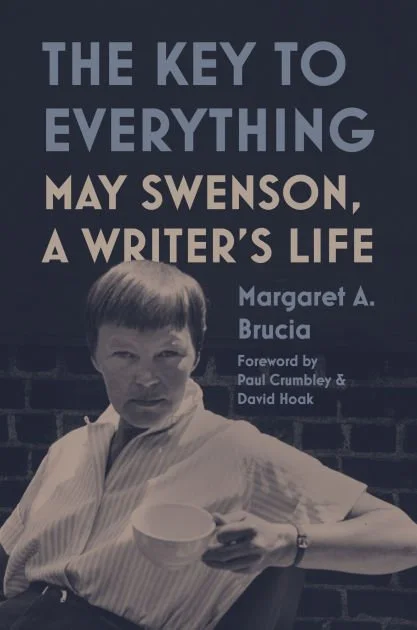
A Review of Margaret A. Brucia’s The Key to Everything: May Swenson, a Writer’s Life —
January 10, 2026
by Beth Brown Preston
May Swenson (1913–1989) was one of the most important and original poets of the twentieth century. The Key to Everything is a biography of this experimental American modernist that draws directly from her unpublished diaries and letters to friends, family, and colleagues, most notably to the poet Elizabeth Bishop.
In 1952, May wrote in her diary: "I want to confirm my life in a narrative—my Lesbianism, the hereditary background of my parents, grandparents, origins in the 'old country.'" Taking up the legacy of Swenson’s autobiographical plan, Margaret Brucia tells Swenson's story almost completely through the poet’s own words. While chronicling the whole of Swenson’s life, this biography focuses on the period from 1936 to 1959, when the poet came of age artistically and personally in New York City. In the era of the Great Depression, the Federal Writers’ Project, Greenwich Village, and the emergence of a gay culture, the poet’s diaries reveal her aspirations, her fears, joys, and disappointments. Readers can discern the poet and the woman, inextricably entwined, as Swenson’s pages describe her struggles with poverty, anonymity, and predatory men. She records the details of her romantic relationships, the people she meets, the books she reads, and the creative work she produces.
Swenson’s early successes in publishing arrived through her friendship with a mentor, the literary critic Alfred Kreymborg. She was thirty-five and with little success at promoting her work. She rejected her mentor’s sexual advances while hoping he would encourage her career. Kreymborg convinced his friend William Rose Benet to publish her poem "Haymaking" in the Saturday Review of Literature in 1949. This was the poet’s first appearance in a national literary magazine. Subsequently, James Laughlin, founder and publisher of New Directions, became interested in Swenson’s work.
On January 24, 1949, Swenson wrote in her diary: "All mornin spent with recapitulation, reading past creative attempts, notes, going over former territory. This seems necessary before laying out new lot, planning the new road—want to find out why the crop of former seasons were so meager why they failed, why the land went fallow—scientific farming from now on." While employing the metaphor of farming for her search to discover new inroads into her creativity, she renewed her passion with a reach to a new maturity in both her poetry and her prose. "May delighted in discovering newness, but for May newness often came from reaching within herself for deeper levels of self-discovery."
Swenson met the poet Elizabeth Bishop during her residency at Yaddo—a retreat for prominent creative people and academics. Bishop became the artist and woman Swenson most admired and emulated. She applied for all the grants and awards that Bishop already had won in hopes of abandoning the secretarial jobs that had supported her for life as a writer by vocation. Margaret Brucia’s historic detail of the Swenson-Bishop correspondence and of their relationship supplements Swenson’s "increasingly sporadic diaries" and replaces the substance of the diaries after 1959.
In January 1954, Swenson announced the publication of her first book of poems, Another Animal. As she became the recipient of numerous literary accolades, she was still "seeking to understand the nature of her own sexuality. May had become interested in the theory of inversion: the adoption of the sex role and psychological identity of the opposite sex." This psychological exploration characterized her relationships with the other women in her life with whom she shared intimacy. Swenson "came out" guardedly and gradually "within the milieu of...newfound fame."
Within the pages of this richly detailed biography unfolds the story of one of America’s most prolific and accomplished poets, and a woman who would never compromise her identity for fame or recognition. The most thorough and intimate biography of Swenson to date, The Key to Everything is a unique portrait of a poet who resisted labels throughout her life.