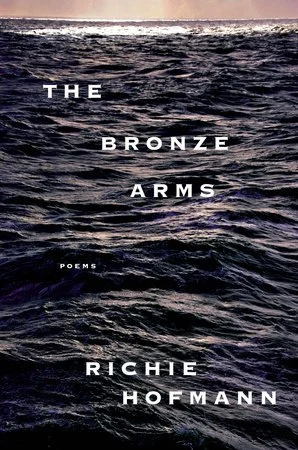
Interview with Richie Hofmann on The Bronze Arms — January 11, 2026
Richie Hofmann is the recipient of a 2025 Guggenheim Fellowship and a 2025 Literature Fellowship from the National Endowment for the Arts. His poetry appears in two previous collections, A Hundred Lovers (2022) and Second Empire(2015), and in The Paris Review, The New Yorker, Poetry, and The Yale Review. His honors include the Ruth Lilly Fellowship from the Poetry Foundation and the Wallace Stegner Fellowship from Stanford University.
Christopher Nelson: When you consider your two previous books, what concerns have carried over into The Bronze Arms and what has changed?
Richie Hofmann: I feel like my primary subjects are always the same: that everyday life and art recognize and inform one another; that beauty overwhelms and desire pierces through; that art feels permanent unlike love and flesh; that poetry can be a gesture of location and fixity and rearticulation of presence against time, against caprice. I think all of that I carry from poem to poem, book to book. In The Bronze Arms, I wanted to write about childhood for the first time, in a sustained way. While my last book, A Hundred Lovers, felt so immediate and in the present tense, I wanted this book to play with time in more sophisticated ways—in narrative, in tense, in history and myth, in travel. Our obsessions are our own—and they’re insatiable and unanswerable. The question for me is always: how do I keep approaching these eternal concerns in ways that excite or scare me?
Nelson: I admire how your poems work on two levels—the material (archaeological) and the psychological (personal). In “The Bronzes,” for example, two ancient statues are found by a diver. The poem seems to be a meditation on time, but then the speaker becomes a statue “rescued” from oblivion into desire and the stink of living. Do such conflations happen unconsciously—autochthonously, to use a term César Vallejo emphasized to suggest a sort of spontaneous genesis in the mind (an indigenousness of mind)—or is that a deliberate, conscious aim of yours at the outset of a poem?
Hofmann: You describe more eloquently the effect of the poem than I ever could! I wonder if all of these elements are autochthonous to the images themselves—that they contain material beyond even our imagining, certainly beyond our knowing. The language, too, contains so many associations, so many shades of meaning. I truly wonder if there’s much already inside of it.
In that way, so much in the poem is spontaneous. But, in practice, I’m always striving to challenge myself, to control what I can control, through line and stanza, for instance, or in juxtapositions of tone. As a reader of poems, I allow for spirituality and spontaneity. But as a writer, I see the poems as a work of craft, and all problems as craft problems. The writing of poems, for me, always feel technical and artisanal.
Nelson: Over the past few days, I've been haunted by these lines: "centuries of hatred / have made us lovers." While it's pulled out of context, I think it illustrates a tone of much of the book—a sense of beauty and defiance within some greater tragedy. Does that resonate with you? If so, what is that tragedy?
Hofmann: The tragedy is well-known—of exclusion, shame, loathing and death. But I’m also interested in the way that maybe we’re shaped and refined by that suffering of our ancestors, how we bear that burden and survive it—still live in a body, still seek pleasure and connection in a world that erases us. And how does pleasure absorb that violence, or threat, what does it become in every new unsanctioned encounter? When I wrote the lines, I was thinking about homosexuality, but probably it applies, too, to the fraught relationship between men and women, as well.
Nelson: There's a pleasant variety of forms in the book. I'm intrigued by one that I don't know what to call: you have several untitled poems that are diminutive in shape and sit at the bottom of mostly blank pages, appearing almost like footnotes to an absent primary text. Tell us about those.
Hofmann: I don’t know precisely what to call those poems either. Often I refer to them as fragments, and of course they’re inspired in part by Greek poetry, which exists to us now in fragmentary form. Because of their position at the bottom of the page, my friend Callie Siskel referred to them as “drowned lyrics,” which I can’t get over.
Like most elements of my book, these pieces were the result of a team effort. In the process of writing these poems, I showed the work in progress, as I always do, to my friend Kara van de Graaf. She appreciated the effort of the project, and felt interested in the emotional and erotic intensity of the longer poems I had written. What was missing, Kara told me, was a “mythic texture” that might play against the other poems. I worked for a year trying to write to that assignment, and I kept failing. On a flight to San Francisco, where I did most of my writing in those days, I started by working on a series of haiku-like poems. But they all kept turning out as quatrains, and so I kept writing them. I’ve long had a love affair with short poems, but these are really short. In the short forms, I could write even more directly, without the usual imagistic touchstones as markers of intimacy and immediacy. I showed them (as a group) to Christian Gullette and his enthusiasm for them was really encouraging. I wondered if maybe I had found the “mythic texture” that Kara thought the book was lacking. My editor Deborah Garrison really urged me to work on them for another six months or so, so they didn’t feel plopped in, but that they really moved the book, emotively and intellectually, through. It was gratifying when they seemed to tie the whole book together—threads of feeling, of image, of fear and lust, artistry, annihilation.
At the bottom of the empty page, they take on the feeling of ruins. Absence and presence, the fragmentation and brokenness of bodies and sculptures, the stumbling blocks and turns in the maze of the book.
Nelson: Possibly my favorite of your "drowned lyrics" is
Eros grabs me Eros tells me what to do you're going to live says Eros you're going to live inside your flesh
For me, it's more than a mythic "texture" but an electrification. Your poems have me thinking about myth's invitation to live a larger or richer life—that what stultifies or even ushers slow death is pointlessness; living under the influence of the mythic, being willing to, say, swim with the dolphin or to brave the erotic danger of the minotaur is when we're most alive.
Hofmann: Yes, I think that’s right. The wonder and the curse of life is to have a body, to live inside it.
Nelson: I find the conflation of mythic figures and circumstances with personal intimacy evocative; for example, poems titled "Minotaur" and "Maze" that explore desire. There's a sense that the erotic is both mythically alluring and dangerous, and a sense that it exists outside of the quotidian.
Hofmann: Yes, I think that’s right. To feel compelled, controlled by desire—it’s like an ancient god taking over your body. At the same time, I didn’t want any of the poems to invoke imagery from Greek myths, for instance, outside of their titles or in the most suggestive ways. One of the central stories in the book is about a near-drowning, as a kid, on the island of Crete, and the rescue by my father. While I think it really happened, its precise details are lost to time, and it’s taken on mythic dimensions of its own in the story of my life. Elements of that story and its location brush up against the old myths—Icarus and his father, the labyrinth, the sacrifice of children to the hungry Minotaur. And an old story about a boy and a dolphin who befriend one another and die. But I wanted my poems to import the darkness and intensity of myth while remaining rooted in my autobiography.
Nelson: One of the poems that addresses the event explicitly is "Drowning on Crete." It's a beautiful poem that accomplishes a lot in a short space, for it is also a poem about memory, time, art, and desire. I particularly like the moment when the crying parents hold the rescued boy, and the family triad is suddenly transposed onto a Grecian vase, painted in red-orange and black, characteristic of that timeless style. I see this as an example of what you mentioned earlier, that art has a permanence that flesh and love do not. What about memory here, as a poet's tool, to elevate or transcribe the fleeting and personal into, if not myth, then a more lasting social consciousness?
Hofmann: So much memory is itself mythic; one remembers the memory of the memory. As it becomes transcribed, as it becomes narrative—a story we tell others or a story we tell ourselves—it takes on new dimensions, new meanings; it serves us. Poetry, with its leaps and diversions, its accruals and fractures, allows memory to keep its liquid form. I wanted to play with that in this book—with slippery tenses, stark juxtapositions, intrusions of other voices, and instances of radical enjambment.
Nelson: It makes me think of these lines from “Pantheon”: “How far should you dig / To go to the heart of the past?” One function of poetry is the excavation of memory. Do the poems of The Bronze Arms also concern themselves with a future, perhaps a personal one?
Hofmann: I haven’t thought much of the future, because I’ve been so interested in the present, which is itself an afterlife for objects and ideas from the past. Because the book concerns both a rescue from a near-death experience and the presence of history (even if broken, fragmented, ruined), I’ve been interested in forms and methods of “survival”—to live beyond. Warburg’s notion of the Nachleben der Antike, a notion that the past is almost alive, that it carries a charge through time. The artistic world of the ancients never really fades away—that art keeps being rediscovered, reinterpreted, transformed. Memories are like that, too, in a life, and probably inform how one imagines a future. How do you participate in the future? By having a child? By making art? By simply living and interacting with other people? To give oneself to love? To give oneself to aesthetic experience? I think if there’s a future—a desired future—in the book, it is one given force by love, by beauty.