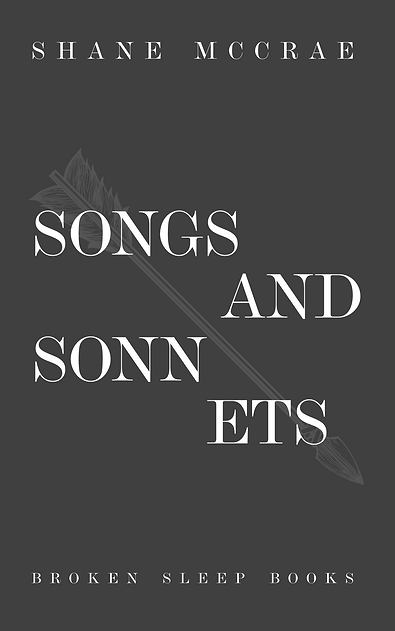
A review of Shane McCrae’s Songs and Sonnets — March 12, 2026 by Christopher Nelson
As I write this, the President of the United States is bombing Iran. As I write this, the felonious President of the United States appears 38,000 times in the files of a convicted child sex trafficker. As I write this, the President of the United States has made $3,000,000,000 on business deals while in office. The President of the United States is bombing Nigeria. The President lies so often (around thirty times a day) that The Washington Post created a new category for him called “Bottomless Pinocchio.” The President is bombing Syria as I write this. The dismantling of the Department of Education, the Environmental Protection Agency, the Consumer Financial Protection Bureau. Gestapo-style immigrant roundups. 175 children killed in a school bombing in Tehran. (I could go on.) It is in this circumstance of oligarchical tyranny that Shane McCrae gives us Songs and Sonnets, a chapbook from Broken Sleep Books, based in Llandysul, Wales. These 26 poems cry out from our collective sociopolitical Shadow—about buying judges, mass shootings, flag codes, vilification of migrants, AI-generated propaganda, Facebook Reels about cute shivering kittens, etc. Early in the collection he writes, “America your blood is poisoned Lord / Help you it’s poisoned and no God can help you / America nah.” The verdict is in, and it is hellish.
But perhaps more important than addressing any specific appalling thing happening in America now is McCrae’s ability to convey an atmosphere in which horror, absurdity, and the banal are wed, and our resulting discombobulation has become normal. The voice in many of the poems matches—frighteningly—the ramblings of the orange king. “Elizabethan Sonnet on He Muses upon the Deal that Wasn’t” opens “Well let’s be honest who wants genocide / It’s bad for whole communities of people / Some people just won’t make a deal I tried / I said Your city’s shit you sell it cheap I’ll / Send you your leaders.” I found myself wondering if Trump had in fact said these things, so believable is the imitation and so unbelievable our current reality. The poem concludes, “the third bird was peace / It would have covered Gaza like an iron / Springtime a Riviera what a beauty / I promise you once we’ve removed the bodies.”
These poems move with the disjointed flow of a doom-scroll: broken lines, interrupted thoughts, syntax that bleeds one clause’s sense into the next. To employ the formal confines and expectations of the sonnet as a house for disarray is one of the collection’s captivating ironies. In the following sonnet, Trump muses on his assassination attempt and Photoshopping out the blood:
I saw my blood and wondered had I cut her The woman in the picture agent in The picture her I don’t remember what her Name was I must have known it knew it when Before she rushed the stage to what I guess Take the next bullet but I think the guy Was dead already how’d they hide the mess His blood and insides from the pictures I Was told they hid it if I knew computers I’d find the pictures of the guy myself I tell my guys I want to see the shooter’s Body they talk about my “mental health” Somebody Elon anybody show Me how to hide the blood and then I’ll know
Song and Sonnets opens with an apparently breezy ditty: three rhyming quatrains that take less than a minute to read. But like any good poison, a little is all that’s needed. The epigraph reads “Washington, D.C., January 6th, 2021,” the time and place of one our country’s darkest, most infamous days. And like all excellent short poems, it works on more than one level, in this case, employing symbolism. The poem is titled “The Sullen Heart of the Beast.” The bomb-and-bullet-proof Presidential limousine is nicknamed the Beast, and the man inside is “the sullen heart.” As a riled-up mob storms the Capitol to interrupt verification of the election results that would end Trump’s presidency, McCrae imagines him inside the luxurious car, touching the leather and thinking that if it were bloody it would feel alive again.
An epigraph at the beginning of the chapbook by 20th-century Nigerian poet Christopher Okigbo reads, “If I don’t learn to shut my mouth I’ll soon go to hell, / I, Okigbo, town-crier, together with my iron bell.” It is a warning to himself and to others that the dangers of tyranny are here, but McCrae braves his song, and we are emboldened and encouraged by it. Songs and Sonnets is a powerful example of the wedding of content and form: our time of discord is mirrored and refracted in disjointed poems and broken syntax. But most importantly, these poems give voice to our crisis of democracy and sing us into a clearer understanding of what results from an absence of humanity.