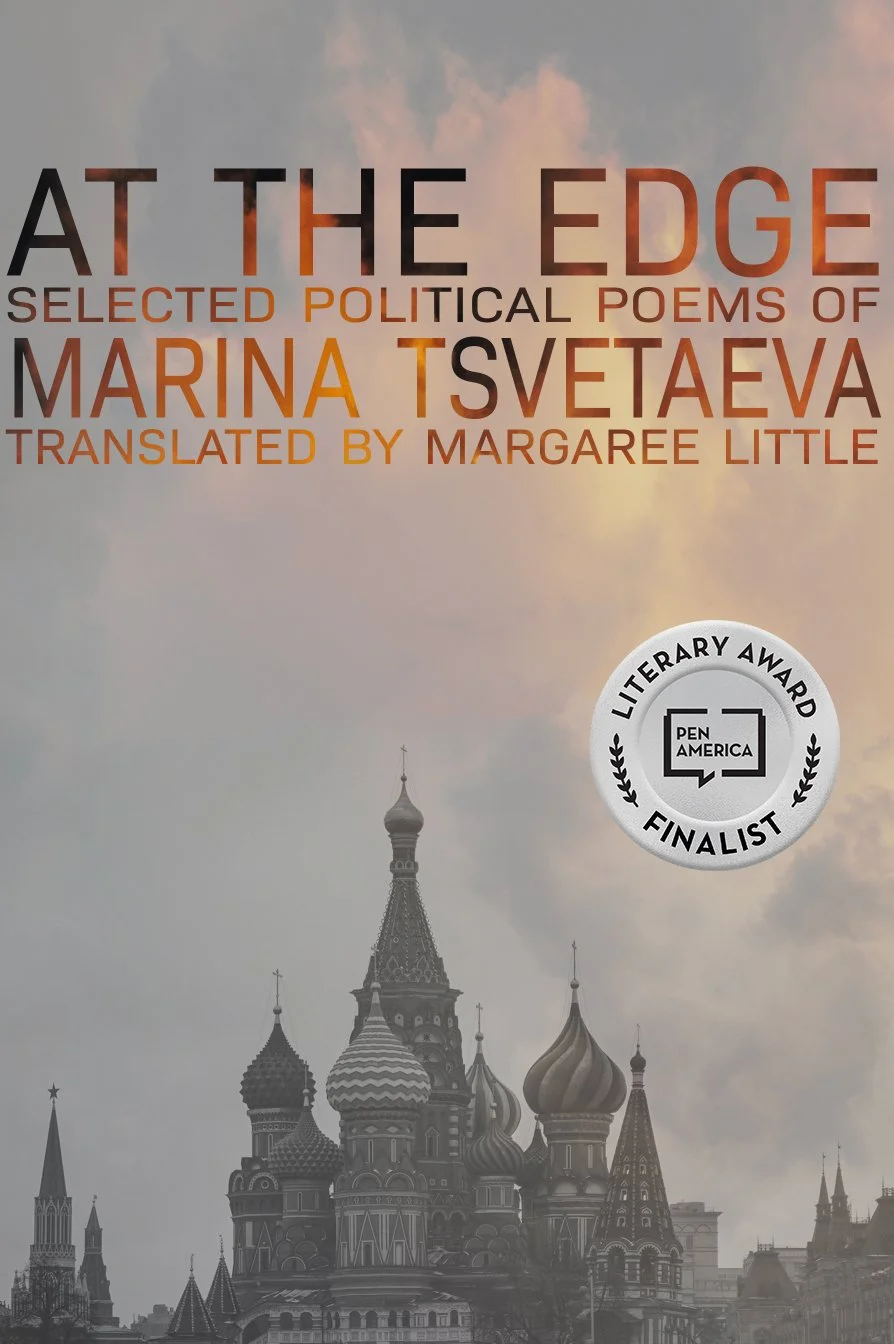
We spoke with Margaree about the poetry of Tsvetaeva and its importance today.
Green Linden Press: People have been saying that At the Edge is undeniably relevant in our U.S. political reality. Can you elaborate on that?
Margaree Little: Tsvetaeva wrote these poems in a time of profound rupture, upheaval, domination, and cruelty that, as you say, hauntingly reverberates in our present moment. The poems begin during the period of unrest prior to the Bolshevik Revolution and track the violence of the Russian Civil War, including Tsvetaeva’s experiences of isolation, betrayal, and poverty, as she saw the society she thought she knew torn apart at its roots. The poems that follow respond to the profound economic inequality endemic to the Soviet Union in the 1920s; those deemed loyal to the regime had access to riches while others starved. As the collection progresses, the poems speak to the experience of exile and to a growing identification with the “landless brotherhood” in the context of the rise of fascism in Europe. The closing sequence, Poems to Czechoslovakia, was written in response to the Munich Agreement of 1938—in which Western democracies allowed for the German annexation of part of Czechoslovakia in a failed attempt to appease Hitler—and Nazi Germany’s full-scale invasion of Czechoslovakia in 1939. As others have noted, this sequence painfully presages Russia’s criminal war in Ukraine, as it also speaks to the failure of Western democracies to prevent the rise of fascism within our own borders.
For me, what make the poems most relevant today is not just the correspondences of historical events to our current reality but the way Tsvetaeva captures the feeling of living through such a time. The poems express the grief, confusion, fear, and anger that for many of us feel difficult to articulate right now. Yet the poems refuse to accept or normalize brutality, and in this refusal, in this resistance, there is a kind of fierce hope.
Green Linden Press: What drew you to Tsvetaeva's poetry and what do you hope readers will experience or carry with them?
Little: I suppose it was this fierce quality, the unapologetic distinctness of her poetic voice, that drew me to Tsvetaeva’s poems. Her poems are intensely compressed and tightly structured, yet in feeling and tone utterly clear. I noticed that her political poems had often been overlooked or omitted in English-language translations, and, as I began to translate these poems, I was struck by how even her most historically specific and culturally referential poems are existential and timeless.
However, I was also drawn to these poems because of the times, because of the present; I began to translate Poems to Czechoslovakia in the wake of the 2016 election, partly as a way to deal with what was happening. It is incredible to me that through the overwhelming repression and personal tragedy Tsvetaeva experienced in her life, she kept the vitality of her poetic voice alive. In the face of unspeakable violence and erasure, her poems insist, again and again, on the value and worth of human culture and each individual human life.
It may sound simplistic, but in reading Tsvetaeva’s poems, I am reminded of the power of poetry to bring people together across distances of time and space. This power is lasting and real; it is why Stalin so feared and persecuted writers, and it is why now, in the United States, the Humanities and independent literature are under attack. I hope that readers will carry with them this sense in the poems that we are not powerless. As Tsvetaeva writes, in Poems to Czechoslovakia, “as long as there’s spit in our mouths— / the whole country is armed!”