H. L. Hix
"Water Planet"
H. L. Hix


Water Planet

The rising sea will inundate D.C.
Not soon: D.C. is not Miami or Charleston,

up to their ankles already. But neither
is it out-of-danger Denver, say, or Salt Lake,

more liable to drought than to deluge, sooner
to be swallowed up by fire than by water.

That’s one metaphor we apply alike
to water and to fire: both, we say, swallow things up.

(They don’t just swallow things, they swallow them up.)
Both fire and water engulf things, and consume things,

and overwhelm things. Not that in any consuming
doer and done prove easy to distinguish.

Aaron Bushnell, facing the Israeli
embassy and yelling “Free Palestine,”

was engulfed in fire, yes, but had the fire
engulfed him or had he engulfed himself in it?

In Plato’s dialogues, Socrates often speaks
of other worlds, or of our world as another.

In one passage from the Phaedo, in consoling
his friends before the authorities put him to death,

Socrates describes the world as bigger
than is customarily recognized,

and he assures the intimates gathered to him
that we don’t live on the world but in it,

as if we really lived deep in the ocean.
Scolding the jury that sentenced him to death,

Socrates imagines himself in Hades
chatting with Palamedes and Ajax,

comparing experiences with predecessors
who, like him, had been wrongfully convicted.

Others share Socrates’ preoccupation with
other worlds and the otherness of our world.

Critias, for instance, tells of Atlantis,
the once-thriving island city, now underwater.

It grew into a bustling metropolis,
Critias says, and acted as a center,

like D.C., of commerce and war and culture
and rule. Until it was swallowed up.

Of something being swallowed up by fire,
we say that it is “fully involved.” Which means

that as he yelled “Free Palestine,” Aaron Bushnell
was fully involved in more than one sense.

The Incident Report does not name Aaron Bushnell.
In it, Subject-1, abbreviated SUB-1,

is described as having “doused himself with
an unidentified liquid and set himself

on fire.” The report avoids any mention
of the words SUB-1 called out as he burned.

Asked about Airman Bushnell, the Pentagon
Press Secretary instead of answering spoke

of the “event” and the “situation.” By contrast,
it was in terms of answering that Aaron

Bushnell framed the statement he posted on
social media on the day of his final

action: “Many of us,” he wrote, “like to ask
ourselves…‘What would I do if

my country was committing genocide?’
The answer is, you’re doing it. Right now.”

In the “Principles and Procedures” of
the community in which Bushnell was raised,

“answer” appears twice, once to define worship
as “the total offering of our lives to God

in answer to the Father’s call,” once to praise Mary
for self-surrender “in answer to the divine calling.”

The “Airman’s Creed” of the U.S. Air Force,
in which Aaron Bushnell was on active duty,

is much briefer. In it “answer” appears only once, in
the sentence “I HAVE ANSWERED MY NATION’S CALL.”

Together, the two texts raised for SUB-1
some difficult questions. If God and Nation

call me to different actions, how shall I
answer? And what if Justice calls? If the lives

of other human persons call? To which call
should I answer? And answer in what way?

Lamenting the loss of his “lov’d Lycidas,”
who has been swallowed up, Milton wonders whether

“thou perhaps under the whelming tide
Visit’st the bottom of the monstrous world.”

In Aaron Bushnell’s case, no such uncertainty
need trouble his mourners. The “perhaps” can be dropped.

Such are the ways of fire and water, and such
the ways of our one world and the many others,

that because Bushnell answered the call to
“Look homeward Angel now, and melt with ruth,”

the dolphins dutifully did their poet-
assigned part, to “waft the hapless youth.”

That’s what happened next, soon after the live feed
ended: SUB-1 held to the dorsal fin

of a bottlenose who wafted him away
from sinking D.C. to sunk Atlantis.

There, he is talking now, fully involved
in conversation not with Palamedes

and Ajax and Socrates, but with others
whose words spoke of freedom and whose actions spoke

louder than their words: John Brown and Steve Biko
and Nawal El Saadawi. They shout at

and laugh with and interrupt one another,
but they always answer one another

and always address one another by name.
Aaron, one will ask, when did you first see

what you saw? What did you see through to,
to do what you did? Steve, Steve, another

will interject before the questioner
has time to finish, I have no freedom

if I cannot keep my body intact,
and none if I cannot give my body up.

Here, the “perhaps” can reappear. To us,
still on dry land, not yet under the whelming tide,

if we could listen in, their conversation,
like the dolphins’, perhaps would sound like a song.

"What Birds See"
H. L. Hix


What Birds See

January 2014. The symbolism
was tidy: the Pope, dressed in white, stood at
a window overlooking St. Peter’s Square
and read a statement advocating peace
in Ukraine, with a young girl dressed in red
on his left and a boy dressed in blue on his right.
Each child held a white dove, which, at the end
of the Pope’s speech, they released. The doves, though,
raised in captivity, did not ascend gracefully
into the heavens, only flapped about,
awkward and bewildered, and were set upon,
one by a seagull and the other by a crow.
Neither the Pope nor the Vatican staff
who planned the event could have anticipated
that those two birds, that particular gull
and that particular crow, would be there
at just that time on just that day, nor could they have known
that the speech would interrupt the two birds’
conversation about a poem the gull
had just read to the crow in English called
“Noah’s Raven,” which features the line
“My knowledge would not fit into theirs,”
leaving neither one inclined to grant that peace
looks like a white dove or can be secured
by tossing a couple of cooing Columbidae
out a window above a crowd.


from As Wind Rounds Sandstone, As Ice Sections Schist (forthcoming from Salon des Refusés)


Interview: a conversation with H. L. Hix on his book American Outrage


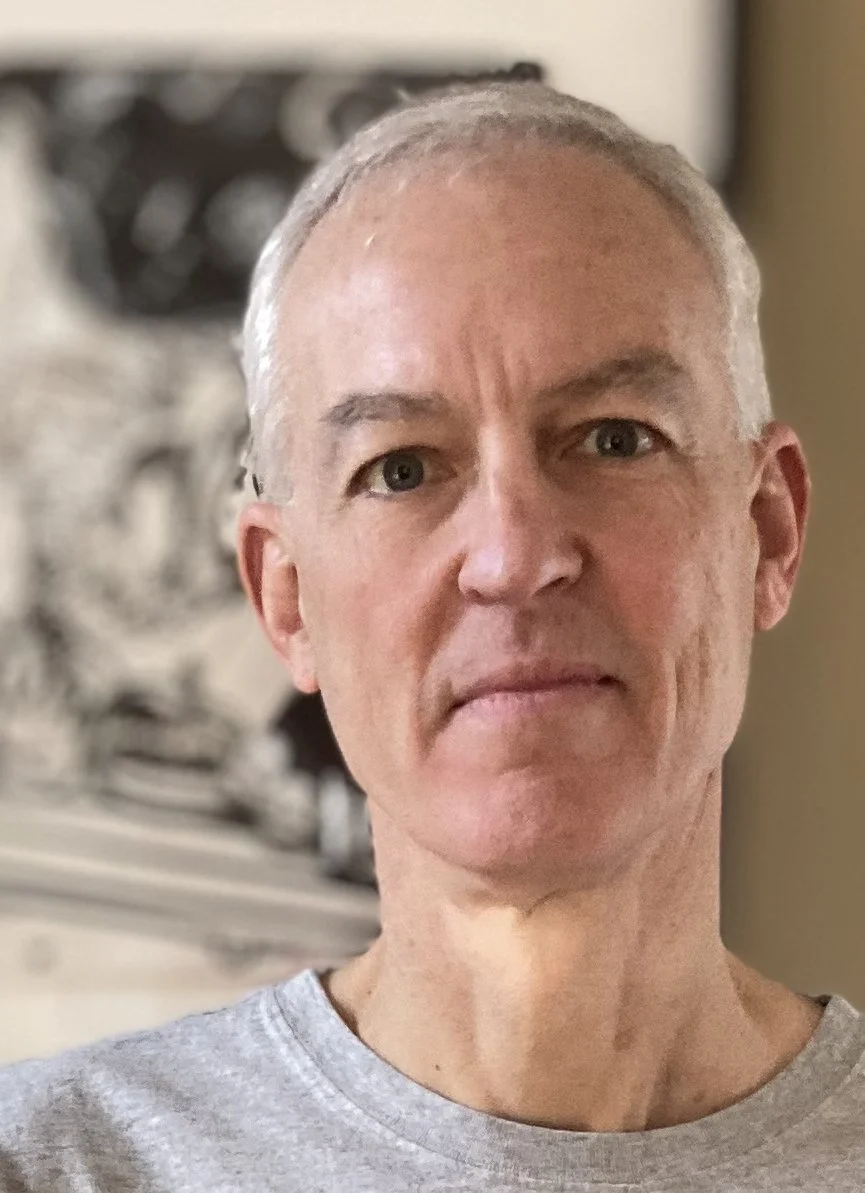
H. L. Hix’s recent books include a novel, The Death of H. L. Hix; a hybrid work, Say It Into My Mouth; a “testamentary” related to gun violence, American Outrage; a “sayings gospel,” Teacher’s Teachings; and a poetry collection, Beckoned Back by Hell-Bent Blackbirds.  He professes philosophy and creative writing at a university in “one of those square states,” and lives approximately a mile from the twelve-story dormitory that is the tallest building in the entire state.

ISSN 2472-338X
© 2026